

Imagine a scenario where a fire breaks out in a high-rise commercial building. In the chaos of alarms and evacuation, a single barrier stands between the raging inferno and the safe exit route for hundreds of occupants. That barrier is not just a door; it is a meticulously engineered life-saving device. This is where the concept of Fire Rating in Fire Rated Doors becomes the most critical specification in modern architecture.
For architects, developers, and safety officers in India, understanding these ratings is no longer just about ticking a compliance box-it is about navigating the stringent safety landscape that has evolved significantly over the last year. With the introduction of tighter norms in the National Building Code (NBC) 2025 and rigorous testing protocols by agencies like CBRI, the margin for error has vanished.
At KOR India, we believe that true safety lies in the details. As a premier manufacturer of fire-rated doors in India, we have seen firsthand how the correct interpretation of fire ratings, from 60 to 180 minutes, can save lives and property. In this comprehensive guide, we will decode the technical jargon of fire ratings, explain the critical “Integrity vs. Insulation” debate, and show you exactly what to look for when selecting a fire door for your next project.
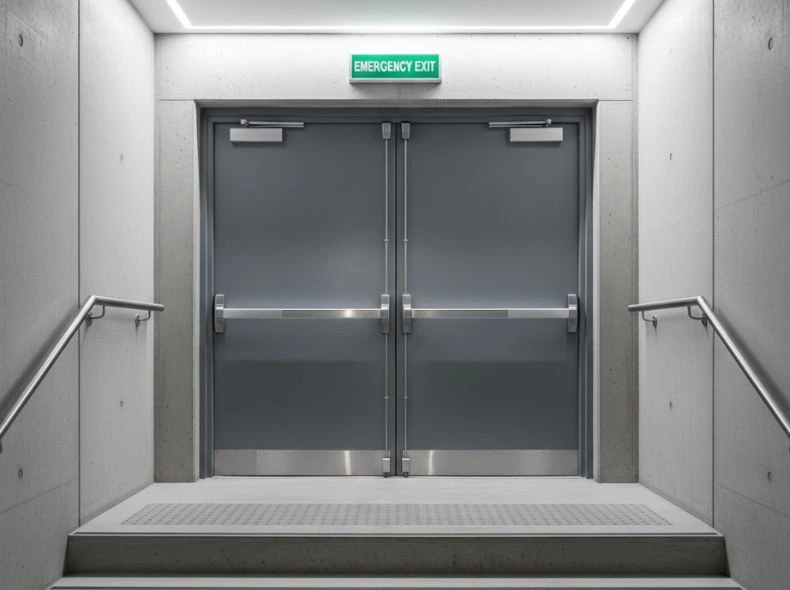
What Exactly is Fire Rating in Fire Rated Doors?
At its core, a fire rating is a certified duration-measured in minutes-that a door assembly can withstand exposure to a standard fire test while maintaining its essential protective functions. It is a promise of performance under extreme stress.
When we talk about Fire Rating in Fire Rated Doors, we are referencing a specific time interval during which the door will:
- Remain securely closed in its frame (Stability).
- Prevent the passage of flames and hot gases (Integrity).
- Limit the heat transfer to the unexposed side (Insulation).
These ratings are not arbitrary. They are derived from destructive testing in controlled furnaces where temperatures soar above 1000°C. Common ratings you will encounter in the Indian market include:
- FD30 (30 Minutes): Typically used in residential apartment entrances or low-risk corridors.
- FD60 (60 Minutes): The standard for commercial office doors and lift lobbies.
- FD120 (120 Minutes): Mandatory for high-risk areas like server rooms, electrical substations, and fire command centers.
- FD180 (180 Minutes): Used in critical infrastructure or hazardous material storage zones.
It is crucial to understand that a “fire-rated door” is an entire assembly. This includes the door leaf, the frame (often galvanized steel), the hardware (hinges, locks, panic bars), and the intumescent seals. If any one of these components fails the test, the entire rating is void.
The Science Behind the Rating: Integrity vs. Insulation
In the technical specifications for projects in Delhi, Mumbai, or Bangalore, you might see cryptic codes like “120/120” or “120/30”. These numbers refer to the Fire Resistance Level (FRL), which is the true benchmark of a door’s capability. The FRL is composed of three distinct criteria:
1. Structural Adequacy (Stability)
This measures whether the door frame and leaf remain upright and do not collapse under the structural load and thermal stress of a fire. For non-load-bearing elements like doors, this is often implicitly covered by integrity, but it ensures the door doesn’t fall out of the wall.
2. Integrity (E)
Integrity is the ability of the door to stop the physical spread of fire. A door fails the integrity test if:
- It develops cracks or gaps wide enough to let flames pass.
- It allows hot gases to ignite a cotton pad held on the unexposed side.
- Flames sustain on the unexposed side for more than 10 seconds.
If a door has an Integrity rating of 120 minutes, it means fire will not physically breach the door for two hours.
3. Insulation (I)
This is often the most misunderstood yet vital component. Insulation measures the door’s ability to stop heat transfer. During a fire, the metal side facing the flames may reach 900°C. If the handle on the “safe” side becomes red-hot, it can severely burn evacuees or ignite curtains and carpets nearby.
- Fully Insulated Doors: These restrict the temperature rise on the unexposed face to below 140°C (average) or 180°C (maximum) for the rated time.
- Uninsulated Doors: These stop flames but allow heat to radiate through.
KOR India Pro Tip: For escape routes like staircases in hospitals and malls, the NBC 2025 strongly recommends using doors with at least 30 minutes of insulation (e.g., FD120 Integrity / 30 Insulation) to ensure occupants can safely pass the door without injury from radiant heat.

Decoding Standards: IS 3614 and NBC 2025
The landscape of fire safety in India is governed by the National Building Code (NBC) and standards set by the Bureau of Indian Standards (BIS). As of 2026, compliance with the latest revisions is mandatory for obtaining your Fire NOC.
IS 3614 Part 2: The Gold Standard
The primary standard for Fire Rating in Fire Rated Doors in India is IS 3614 Part 2. This standard outlines the methods for fire resistance tests for metallic and non-metallic fire doors. KOR India’s doors are rigorously tested under this standard at NABL-accredited laboratories like CBRI Roorkee.
Key Aspects of IS 3614 Compliance:
- Vision Panels: Glazing must be fire-rated (e.g., borosilicate or ceramic glass). Ordinary toughened glass will shatter in minutes.
- Gap Analysis: The gap between the door and frame must be minimal (typically 3-4mm) to prevent smoke leakage.
- Labelling: Every fire door must carry a permanent metal label detailing the manufacturer, rating, and year of manufacture.
NBC 2025 Updates
The recently discussed NBC 2025 drafts and subsequent finalizations have introduced stricter norms:
- Mandatory Smoke Seals: Smoke inhalation causes more deaths than fire itself. New norms emphasize “S” ratings (Smoke Control) alongside fire ratings.
- Hospital & School Safety: Regardless of building height, institutions with high occupancy now require higher-spec fire doors for compartmentation.
- Third-Party Audits: Self-certification is being replaced by mandatory third-party inspections to ensure the installed door matches the tested prototype.
The Testing Process: How KOR India Ensures 100% Compliance
At KOR India, we don’t just manufacture doors; we engineer safety. Understanding the testing process helps you appreciate the robustness of our products.
- The Furnace Test: The door is mounted in a test wall and placed against a furnace. The temperature follows a standard time-temperature curve (ISO 834), reaching approx. 945°C at 60 minutes and 1150°C at 240 minutes.
- The Hose Stream Test: Immediately after the fire endurance test, while the door is still red-hot, it is blasted with water from a fire hose at high pressure. This simulates the thermal shock of firefighting efforts. The door must not crumble or blow open.
- Cycle Testing: Before the fire test, the door is subjected to thousands of opening/closing cycles to prove durability. A fire door that sags or jams in daily use is useless in an emergency.
Our Scientific Fire Doors are tested to withstand these brutal conditions, ensuring that when you install a KOR India door, you are installing a certified shield against disaster.
Choosing the Right Fire Rated Door for Your Project
Selecting the correct Fire Rating in Fire Rated Doors can be confusing. Use this quick guide to match the rating to the application:
| Application Area | Recommended Rating | Key Requirement |
| Main Entrance (Flat/Office) | FD60 (60 Mins) | Aesthetics + Security + Fire Integrity |
| Staircase Enclosures | FD120 (120 Mins) | Panic Bars + Smoke Seals |
| Server / UPS Rooms | FD120 (120 Mins) | High Insulation to protect data/equipment |
| Electrical Shafts | FD120 (120 Mins) | Durability & Secure Locking |
| Basement Parking Exits | FD120 / FD180 | Heavy Duty Steel Construction |
Material Matters:
While timber doors are popular for aesthetics, Steel Fire Rated Doors (like those from KOR India) offer superior durability, stability, and higher fire ratings (up to 180 minutes). They are resistant to warping, rot, and termites, making them the ideal choice for long-term compliance.

Installation: The “Achilles Heel” of Fire Safety
You can buy the best FD120 door in the world, but if it is installed poorly, it might offer only 10 minutes of protection. The gap between the frame and the wall is a common failure point.
- Fire Stopping: The void between the steel frame and the masonry wall must be filled with fire-rated mortar or mineral wool, not just standard PU foam.
- Hardware Compatibility: Replacing a fire-rated lock with a cheap local latch can void the certification. Always use the hardware specified in the test certificate.
- Door Closers: A fire door must be closed to work. High-quality hydraulic door closers are non-negotiable.
KOR India provides comprehensive installation support to ensure that the “As-Installed” performance matches the “As-Tested” rating.
Why Choose KOR India?
In a market flooded with unverified claims, KOR India stands as a beacon of trust. We are not just vendors; we are partners in your safety strategy.
- Certified Excellence: Our doors are tested at CBRI and comply with IS 3614, BS 476, and UL standards.
- Customisation: From 180-minute scientific doors to acoustic fire doors, we tailor solutions to your architectural needs.
- Complete Ecosystem: We manufacture the door, frame, and provide compatible certified hardware (panic bars, trim, vision panels).
- Pan-India Presence: Whether your project is in Noida, Mumbai, or Hyderabad, our support network ensures timely delivery and service.
When you specify KOR India, you are choosing peace of mind.
Frequently Asked Questions (FAQ)
Q1: What is the difference between an “Insulated” and “Uninsulated” fire door?
A: An uninsulated door (Integrity only) stops flames but gets very hot on the safe side. An insulated door contains a special core (like mineral wool) that keeps the safe side cool enough to touch, preventing burns and secondary fires.
Q2: Can I paint a fire-rated door?
A: Yes, but you must use compatible paints that do not increase flammability. KOR India provides powder-coated finishes that are factory-applied and fully compliant.
Q3: How often should fire doors be inspected?
A: According to the latest safety norms, fire doors should be inspected every 6 months to ensure closers, seals, and latches are functioning correctly.
Q4: Is a “Fire Resistant Door” the same as a “Fireproof Door”?
A: No material is truly “fireproof” forever. “Fire-resistant” or “Fire-rated” means it protects you for a specific certified time (e.g., 60 or 120 minutes), which is what building codes require.
Q5: What is the minimum fire rating required for a high-rise lift lobby?
A: Typically, NBC requires a minimum of 60 minutes (FD60) for lift lobby doors to prevent smoke and fire from traveling vertically through the shaft.
Conclusion
Understanding Fire Rating in Fire Rated Doors is the first step toward building a safer India. Whether you are retrofitting an old office or designing a state-of-the-art hospital, the integrity of your fire doors is paramount.
Don’t leave safety to chance. Partner with a manufacturer that prioritizes rigorous testing and compliance. Contact KOR India today for a consultation on your fire safety needs, and let us help you secure your project with doors that are built to save lives.
[Explore KOR India’s Fire Door Range] | [Download Our Brochure] | [Request a Quote]